
Episódio Anterior
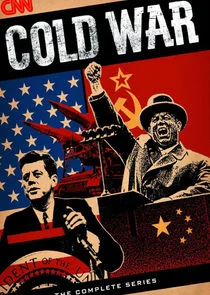
S01E24 - "Conclusions (1989–1991)"
Foi ao ar em May 9, 1999, 4:00 PM
Próximo Episódio
Série Encerrada
Descrição
Episódios (1 Temporada · 24 Episódios)
Comrades (1917-1945)
Once allies against HItler, the Soviet Union and the United States confront each other at the end of World War II. Looming over the postwar landscape is the awesome, mushroom-shaped cloud of the atomic bomb.
Sep 19, 1998
60 min
Iron Curtain (1945–1947)
In the months following their victory in World War II, the alliance between the Soviet Union and the West quickly proves to be little more than a marriage of convenience. Suspicion clouds relations -- while a curtain descends over Europe.
Sep 26, 1998
60 min
Marshall Plan (1947–1952)
With hunger and discontent plaguing postwar Europe, the U.S. proposes an aid program to rebuild the ruined continent.But the Marshall Plan also solidifies the deep ideological differences between East and West.
Oct 3, 1998
60 min
Berlin (1948–1949)
Three years after the end of World War II, the Nazis' former capital, Berlin, would once again find itself the target of an allied air fleet. This time, the air armada was working to save, rather than destroy, the city.
Oct 10, 1998
60 min
Korea (1949–1953)
It was one of the few times the Cold War went hot. The conflict on the Korean peninsula claimed millions of lives, and set the stage for the way both sides would view each other for years to come.
Oct 17, 1998
60 min
Reds (1948–1953)
As the Cold War intensifes, so do fears in the Soviet Union and the United States of outside influences -- prompting massive campaigns to purge the "enemy within."
Oct 31, 1998
60 min
After Stalin (1953–1956)
In 1953, the death of Soviet dictator Joseph Stalin creates a power vacuum in the Kremlin's leadership. It also unleashes a wave of unrest in Eastern Europe, as some Soviet satellites test the limits of Moscow's tolerance.
Nov 7, 1998
60 min
Sputnik (1949–1961)
The Soviet atomic bomb gives birth to a new arms race -- which turns into a space race. But any promising technological advances are overshadowed by the threat of long-range nuclear destruction.
Nov 14, 1998
60 min
The Wall (1958–1963)
For years, West Berlin was an escape route for East Germans seeking to flee communism. But growing Cold War tensions forced the Soviet bloc to erect a deadly blockade across the city -- a Wall that divided Berlin for nearly three decades.
Nov 21, 1998
60 min
Cuba (1959–1962)
The emergence of a communist government in Cuba heightens Cold War tensions -- and for several terrifying days brings the world to the brink of nuclear war.
Nov 28, 1998
60 min
Vietnam (1954–1968)
It was a conflict that devastated one nation and divided another. Vietnam brought a new dimension to the Cold War -- and forced the United States to rethink its goals in the superpower rivalry.
Dec 12, 1998
60 min
MAD (1960–1972)
With Cold War tensions heightening at the start of the 1960s, the superpowers are drawn into an escalating arms race. The world's safety depends on a nuclear paradox known as "mutual assured destruction."
Dec 12, 1998
60 min
Make Love Not War (The 60s)
In the 1960s the United States claimed its place as the world's leading defender against communism. But by the end of the decade, the nation was convulsed by dissent, riot, assassination and an increasingly unpopular war.
Feb 13, 1999
60 min
Red Spring (The 60s)
In the 1960s, as dissent and protest swept through the West, nations of the Warsaw Pact were experimenting with reforms. But hopes for change were crushed by palace coups and, in the case of Czechoslovakia, outright invasion.
Feb 20, 1999
60 min
China (1949–1972)
The emergence of the People's Republic of China signals a new and dangerous phase in the Cold War. But a split between Moscow and Beijing opens the door for a change in U.S.-Chinese relations
Feb 27, 1999
60 min
Detente (1969–1975)
By the end of the 1960s, the United States and Soviet Union faced a choice: slow down their Cold War competition -- a process that would be called détente -- or continue an arms race that could end in all-out war.
Mar 6, 1999
60 min
Good Guys, Bad Guys (1967–1978)
The Cold War takes on a new dimension as the Soviet Union, the United States and their allies become involved in wars between rivals in Africa and the Middle East.
Mar 13, 1999
60 min
Backyard (1954–1990)
Central America, the Caribbean and South America become the battleground for a test of wills between the United States and the U.S.S.R. -- as the Cold War comes to America's "backyard."
Mar 20, 1999
60 min
Freeze (1977–1981)
In 1976, Jimmy Carter and Leonid Brezhnev promised to reduce East-West tensions. But within four years those promises turned to anger and mistrust. The Cold War was far from over.
Mar 27, 1999
60 min
Soldiers of God (1975–1988)
For centuries, nations had tried to conquer Afghanistan. None succeeded. But the Cold War -- and an Afghan civil war -- would bring a terrible toll of death and destruction to the people of this traditionally Islamic land.
Apr 11, 1999
60 min
Spies (1944–1994)
The Cold War was fought on two fronts. In public, it was a series of confrontations and crises. But the East and West also battled in the shadows, as intelligence agents risked their lives to steal secrets.
Apr 18, 1999
60 min
Star Wars (1981–1988)
In 1981, Ronald Reagan -- a strident Cold Warrior -- enters the White House on a platform of "making America strong again." Convinced the United States is lagging in the arms race, Reagan increases defense spending and proposes a "Star Wars" anti-missile system -- alarming leaders in Moscow.
Apr 25, 1999
60 min
The Wall Comes Down (1989)
For nearly three decades, the Berlin Wall symbolized the Iron Curtain that separated East from West. But by 1989, the Wall was starting to crumble -- and by the end of the year it would collapse.
May 2, 1999
60 min
Conclusions (1989–1991)
It is the twilight of the Soviet empire. With the fall of the Berlin Wall, the Kremlin loses its iron-fisted grip on Eastern Europe. As events spiral out of control, Mikhail Gorbachev finds his authority challenged from within -- both from communist hard-liners, and from a popular reformer named Boris Yeltsin.
May 9, 1999
60 min